Showing posts with label Canadian Zinc. Show all posts

Monday, May 9, 2011

Hunt for Silver - Canadian Zinc

Hunt for Silver - Canadian Zinc
April 24, 2010


The first "Hunt" in the Hunt for Silver refers to the Hunt brothers family led by Nelson Bunker Hunt, the many children of the Texan oil billionaire who were notorious in being the prime factor in the  1980's Silver price rise to $50 (Eichenwald, 1989):
Silver prices rose from $11 an ounce in September 1979 to a peak of about $50 an ounce in January 1980. The price of silver then collapsed, falling below $11 an ounce in about two months.
Nelson Bunker had formed the idea of investing in the Silver commodity in 1970, when it was still only $1.50 an ounce (Swanson, 2009).  By 1974, he had over 9% of the world's free supply, with Silver priced then at $3 USD (Tillberg, 2011), of 55 million ounces in futures contracts under the Hunt family umbrella.  For $175 million dollars the Hunts took delivery, which was considered unusual for speculators.  Then under the guard of a dozen armed Texas cowboy marksmen (LaBorde, 2011), the Hunts secretly transported a portion of their bullion using unmarked Boeing jets from New York to storage in 6 Switzerland vaults (Hurt III, 1980).
Later, on July 1, 1979, in Bermuda, the Hunts formed the International Metals Investment Company together with two affluent Arabs, Sheikh Ali bin Mussalam and Sheikh Mohammed Aboud al- Amoudi (Markham, 2002) as partners for Silver investment.  This company bought 43 million ounces of Silver.  Another associated investor Naji Robert Nahas, an Egyptian born Brazilian, in partnership with Norton Waltuch, bought 42 million ounces of Silver (Tillberg, 2011).  There were other unidentified Middle Eastern traders that were Silver buyers in the fall of 1979.   
On October 3, 1979 when Silver had risen to $17.88 USD (Hurt III, 1980), the Chicago Board of Trade (CBOT) changed the rules so that no traders could hold more than 3 million ounces of Silver futures (Maloney, 2011).  Those holding more were forced to liquidate.  Then on January 7, 1980, COMEX the other exchange, also changed the rules limiting investors to 10 million ounces of Silver futures and any overage had to be liquidated.  The January 21, 1980 peak of the Silver price rise was $49.45 USD based upon the London PM fix (Silver Institute, 2011), with Silver futures priced at $52.50 USD (Maloney, 2011).  It is estimated that the Hunts and their allies controlled 77% of the world's Silver at that time (Tillberg, 2011).  That same day , January 21, 1980, COMEX, with the backing of the Commodities Futures Trading Commission (CFTC) in Washington, announced liquidation orders only, no new buying (Maloney, 2011).  The Silver price began to plummet.  As some of the Hunt holdings were purchased on margin, with the dropping Silver price, the Hunts had to find more funds.  This they did, using their other investments until March, 1980.  On March 14, 1980, Volker, then head of the US Federal Reserve decreed that banks could not make loans for speculation in precious metals (Tillberg, 2011).  Now the bank sources of funding for the Hunts dried up.
The climax of the unravelling of the Silver prices came on "Silver Thursday" (Wikipedia, 2011), March 27, 1980, in a $100 million margin call for the Hunts.  They faced a $1 billion USD in losses on that one day.  The Hunts' Silver holdings were estimated to have been $10 billion at the peak and had dropped to around $3 billion earlier that Thursday  (Time Magazine, 1980).  Then the Silver price collapsed from $21.50 to $10.20 within 3 days (Time Magazine, 1980).
Following these wild Silver price gyrations, the CFTC in 1981 set speculative position limits in futures contracts to forestall future attempts to corner commodities (Stephenson, 2011).  The two Hunt brothers, Nelson Bunker Hunt and William Herbert Hunt  were charged by the CFTC in 1985 (CFTC, 2007) after an investigation that they had attempted to manipulate Silver prices in 1979 and 1980.  Because of these charges, legal proceedings and fines, the Hunts filed for bankruptcy protection in September, 1988 (Wikipedia, 2011).  In 1989, Nelson Bunker Hunt settled with the CFTC (Eichenwald, 1989).
William Bunker Hunt's reason for investing in Silver was stated as (Time Magazine, 1980):
"Silver looked safer than overseas oil concessions, the way things were going.  And precious metals were a good hedge against paper money."
Now in April, 2011 the second "Hunt" for Silver may just be occurring at the present time, not by a group of a few rich investors, but as the savings of choice of the new emerging market's middle classes as the Silver prices are closing in on the 1980's record price of $49.45 USD.  See the 10 year price for Silver following:
As of this writing on Easter weekend the Silver price has closed trading at $46.45 USD while the price overseas is flirting at over $47 USD.
One related investment that the Hunt's had during the last Silver price run was the Prairie Creek mine in northern Canada.  The mine infrastructure was 95% completed in 1982 when the property was placed into receivership.  This rich Silver, zinc, lead mine was to become a cornerstone in the Hunt's Silver empire, but due to the Silver price collapse, the property was unclaimed until purchased in 1992 by San Andreas Resources now renamed as Canadian Zinc (US:  CZICF, Cdn: CZN).
This mine is distinguished by their high grades of ore, with an average grade of 155g of Silver, 12% zinc, 10% lead and .3 % copper per ton of ore.  At today's prices, the ore is worth over $700 per ton.  There are 6 million tons of Measured and Indicated (M&I) Resources with a further 6 million tons of Inferred Resources from the 2007 technical report.  That gives a value of $4.2 billion USD of metals in the ground by counting only the M&I Resources (another $4.2 billion for the Inferred).  Using a rule of thumb for a market valuation scale of from 2% for a discovery to  24% for in production, if we apply a 12% of the in ground value for the M&I Resources over the 138 million share float, the stock value comes to over $3 USD per share.
The found strike length of the resources is over 16 kilometres long with the originally discovered vein mineralization.  Recently, stratabound mineralization has been found to be coincident with the vein structure.  This stratabound style of mineralization is much thicker and exploration is in progress for further discoveries along the veins.
In the author's opinion, Canadian Zinc is poised for upside with the rising metals prices, pending permit approvals and forthcoming exploration successes.
References:
CFTC. (2007). Significant Dates in CFTC History - 1980s. Retrieved April 23, 2011, from www.cftc.gov: http://www.cftc.gov/reports/strategicplan/2012/2012strategicplanapp0202.html
Eichenwald, K. (1989, December 21). New York Times - Business Day. Retrieved April 23, 2011, from New York Times: http://www.nytimes.com/1989/12/21/business/2-hunts-fined-and-banned-from-trades.html
Hurt III, H. (1980, September). Silver Finger. Retrieved April 23, 2011, from sharelynx.com: http://www.sharelynx.com/papers/BunkerHunt.php
LaBorde, L. (2011). H.L. Hunt and the Circle K Cowboys. Retrieved April 23, 2011, from rapidtrends.com: http://www.rapidtrends.com/hunt-brothers-and-silver-story/
Maloney, M. (2011). How the Hunt Brothers Capped Gold...Yes, GOLD! Retrieved April 24, 2011, from www.silver-info.com: http://www.silver-info.com/how-the-hunt-brothers-capped-gold.htm
Markham, J. (2002). A financial history of the United States. New York: M. E. Sharpe Inc.
Silver Institute. (2011). Price History 1979 to 1980. Retrieved April 23, 2011, from www.silverinstitute.org: http://www.silverinstitute.org/19791980.php
Stephenson, E. (2011, Mar 28). Timeline - US CFTC road to reform. Retrieved April 23, 2011, from reuters.com: http://in.reuters.com/article/2011/03/28/financial-regulation-timeline-cftc-idINN2818930520110328
Swanson, D. J. (2009, March 22). Once world's richest man, Bunker Hunt has "no regrets" 29 years after silver collapse. Retrieved April 24, 2011, from www.txcn.com: http://www.txcn.com/sharedcontent/dws/dn/latestnews/stories/032209dnprobunkerhunt.3d93ff8.html
Tillberg, J. (2011, March 4). The hunt Borthers, How they Did It and What we Can Learn From it. Retrieved April 28, 2011, from Seekingalpha.com: http://seekingalpha.com/instablog/170390-jason-tillberg/144117-the-hunt-brothers-how-they-did-it-and-what-we-can-learn-from-it
Time Magazine. (1980, April 14). Business: The Hunts Are on the Hunt. Time .
Time Magazine. (1980, April 7). Nation: He has a Passion for Silver. Time , p. 1980.
Wikipedia. (2011, April 22). Nelson Bunker Hunt. Retrieved April 23, 2011, from en.wikipedia.org: http://en.wikipedia.org/wiki/Nelson_Bunker_Hunt
Wikipedia. (2011, April 21). Silver Thursday. Retrieved April 23, 2011, from en.wikipedia.org: http://en.wikipedia.org/wiki/Silver_Thursday#cite_note-0
Disclosure: The author is long Canadian Zinc.

Important Disclaimer
The information and opinions contained within this document reflect the personal views of the author. There are no guarantees of the accuracy, reliability or completeness of the information contained herein. Independent due diligence and discussions with one’s own investment and business advisor is strongly recommended. These writings are not to be construed as an offer or solicitation with respect to the purchase or sale of any security. We do not request or receive compensation in any form in order to feature companies in this publication. It is prohibited to copy or redistribute this document to any type of third party without the express permission of the author. This document may be quoted, in context, provided proper credit is given.

Friday, November 5, 2010

China Moves & Implications for Commodities & Metals

China Moves & Implications for Commodities & Metals
November 5, 2010
By:  Marco G.

On November 3, 2010, Bloomberg had this title "China to Sell 50,000 Tons of Zinc From Reserves as Power Cuts Lift Prices".  From that report, we get a glimpse of what China has been stockpiling:

China bought 235,000 tons of copper, 590,000 tons of aluminum, 159,000 tons of zinc, 30 tons of indium and 5,000 tons of titanium for reserves, Caijing magazine reported in June last year,
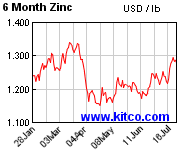
In hindsight, it was in plain sight and obvious, China was using their US currency reserves and exchanging them in return for goods with hard value, the metals, for their strategic stockpiles.  They are definitely growing for the foreseeable future and these materials will be needed for their infrastructure building.  This information of China releasing a portion of their Zinc stocks into their marketplace, indicates a possible forthcoming shortage (a secondary reason is in the above article - power cutbacks will reduce production).  Take a look at Kitco's six month Zinc price chart.  Since June of this year, Zinc has moved from 70 cents USD a pound to the price of $1.13 today.  Zinc's main usage is in industry as an anti-corrosion coating for steel.  For Zinc prices to move like that and the stated Chinese anticipating a shortage coming, means that construction and infrastructure building is increasing.  This Chinese positioning tells us that economic revival is at hand, never mind the noisy pundits that are still distracting us and calling for caution, double dip is ahead.

Precious Metals Bull

In the midst of the commodities and metal prices up swing, the precious metals are enjoying their own boom.

Last week, the Commodities Futures Trade Commission (CFTC) alleged market manipulation in silver markets:

Oct 26 (Reuters) - There have been repeated attempts to influence prices in silver markets, Bart Chilton, a commissioner at the U.S. futures regulator, said on Tuesday.

The precious metals markets responded brightly as the news was disseminated and investors felt that the scrutiny would cause the perpetrators to refrain and the markets would move higher. 

Recently there is much speculation in the precious metals blogs about large Asian players buying into the precious metals.  This adds further to the raucous behaviour of the precious metals prices.

Irfan Chaudhry, another Seeking Alpha contributor, recently presented good research about Central Banks buying back into Gold:

·         Central banks will keep diversifying their reserve holdings into gold without trying to convey any price information to the market.
·         US dollar part of reserves has seen most of diversification as dollar reserves have declined more than euros and other currency reserves. Expectation of further weakness of dollars may exacerbate this trend (a positive feedback)
·         China, Middle Eastern countries, Russia and India will stay as most aggressive diversifiers of their reserves into gold.
These reported Central Bank actions would explain some of the price supports for the precious metals overseas.

Mining Juniors

The China moves with Zinc and the precious metals boom make for an interesting time in the markets.  "Interesting" in this context means exuberant, especially for small metals miners. 

The author has stated his preferences in small metals miners as in mining Juniors in his previous articles on Seeking Alpha. 

For selection of companies to invest in, the author uses one attribute as paramount for success - the quality of management of the company.  All other company attributes such as projects, locations, grades, etc. fall by the wayside in importance, relative to the perseverance, integrity and intelligence of the small company management.  It all comes down to whether the management's goal is to create sustaining value for the shareholder.

Mining Environmental Side Note

As a counter example, the Canadian government recently delivered a rounding blow to Taseko Mines (TGB) on November 1, 2010.  In a scathing rebuke to the Canadian miner about their proposed  copper and gold "Prosperity" project in British Columbia, Environment Minister Prentice denied their operating permit. 

Though the mine was supported by the  provincial government, there was concerted first nations opposition to the project.  The opposition was centered around lack of consultation and the proposed filling in of a lake with mine tailings.

Franco-Nevada (FNNVF.PK) is also affected by this development as they had signed a royalty agreement in May 2010 of $350 million with Taseko for future off take of the Gold production from Prosperity. 

Due to the inability of Taseko's management to handle the environmental impacts, Taseko's stock price dropped 30% on the government denial.

Investor Action

The author sees much upside ahead for commodities, metals and junior miners in the markets.  Investors are advised to be selective in their choices of mining equities, for the possible gains to be sustainable.  The author is participating in the metals, gold and silver bull markets and has invested in junior metals and precious metals mining equities.

Disclosure: The author is long junior mining equities.
Important Disclaimer

The information and opinions contained within this document reflect the personal views of the author and should be viewed as food for thought and amusement only. The author may from time to time have a position in any of the securities mentioned. There are no guarantees of the accuracy, reliability or completeness of the information contained herein. Independent due diligence and discussions with one’s own investment and business advisor is strongly recommended. These writings are not to be construed as an offer or solicitation with respect to the purchase or sale of any security or as an endorsement of any product or service. We do not request or receive compensation in any form in order to feature companies in this publication. It is prohibited to copy or redistribute this document to any type of third party without the express permission of the author. This document may be quoted, in context, provided proper credit is given.

Friday, October 1, 2010

Silver Stealth in Gold Bull Market

Silver’s Stealth in Gold Bull


By: Marco G.

September 30th , 2010

http://goombarhsedge.blogspot.com/


I’ll bet that you the reader thought that the Gold Bull was strong in September, didn’t you? Yes, Gold was strong gaining in price by 5% over the month and hitting a high of $1315 USD on September 30th before closing at $1308 for the end of the month. Well, would it surprise you to know that Silver made the stronger moves in September gaining 12.4% for the month and hitting a high of over $22.08 USD before closing at $21.78 for the end of the month.

Silver Stealth Bull

Silver is following the higher priced Gold in the Bull market for precious metals this fall. In the Google Trends chart following, the search term “Gold Price” turns out to be four times as popular as the search term “Silver Price”.

 
So, Silver is gaining more on a percentage basis, but in terms of popular awareness the Bull market for Silver is still operating in “Stealth” mode.

Silver versus Gold Gains for September

Continuing in my mode as a Silver enthusiast, the author decided to run some statistics on Silver stock gains for the month in comparison to Gold. Note that the author definitely said gains and did not use the word moves, so sure he is that there were gains across the board. In the chart following the author displays the surprising findings.

Using the GLD ETF as a proxy for the Gold price, the gain for Gold was 5.1% for the month from September 1st end of day to September 30th end of day prices. The source of the prices were from Yahoo Finance. The surprising thing is that the SLV ETF as a proxy for the Silver price gained more than twice as much as Gold coming in at a 12.4% gain. The usual explanations for the Silver strengths are two fold. Firstly, Silver being also an industrial metal as well as a precious metal collapsed more severely than Gold did during the 2008 economic crisis. Since then, Silver is only presently recovering to the highs reached since before the crisis. Therefore, Silver had a longer way to catch up percentage wise. The second reason, is that Silver is a much smaller market than for Gold and is therefore more volatile.

Gold Miners

The large Gold miners ETF, the GDX gained 5.8% for the month relative to the metal’s price gain of 5.1%. This would seem as if there was almost no leverage for owning the equities as opposed to owning just the metal. The author suspects that the market for large Gold mining equities may be saturated for lack of a better word. The Gold producers’ costs are higher due to the inflating energy and production costs plus the market just does not appreciate the large cap miners’ stories as much anymore. This is a trend that investors had better keep an eye upon. Large cap miners are just not providing any leverage to Gold presently.

Just for fun, the author decided to checked out the gain for the high quality stock Gold Corp (GG, TSX:G). Gold Corp’s gain for the month was a paltry .003%. Amazing! What is the story here? Well, if the reader recalls, Gold Corp is purchasing Andean Resources (ANDPF, TSX:AND) for $3.4 billion USD. The author expressed an opinion here that Gold Corp was paying too much. It appears that the market may agree with the author and is penalizing Gold Corp for this.

The smaller Gold miners in the GDXJ ETF gained a respectable 9% for the month. Juniors are providing a leverage of almost 80% more than gains made by the underlying Gold price. This is a trend that investors should be watching, as the author believes the market monies are presently moving to the smaller names in mining.

Silver Miners

Silver is where the big gains story is this month, with the shining metal sporting a 12.4% hike. The author is using the Silver ETF SLV as a proxy for the Silver price in the chart following.

The Silver miners are gaining even more by leveraging the Silver price. Under cover of the Gold bull market, the Silver producers as a group are enjoying their own “Stealth” Bull with double digit gains.


Silver Miners ETF SIL gains 15.1%.
 
SIL gained 15.1% and that is still a respectable leverage to Silver as the ETF is a mixed bag of large cap and junior Silver miners. The following four large Silver producers comprise over 50% of this fund: Silver Wheaton (SLW), Fresnillo PLC (FNLPF), Pan American Silver (PAAS), Industrias Penoles (IPOAF). The author reviewed the SIL ETF in a previous article here?


Silver Wheaton (SLW) gains 18.4%
 
Silver Wheaton (SLW), the author’s “crème de la crème” Silver royalty stock turned in a marvelous performance this month with a gain of 18.4%. Silver Wheaton buys into the operating mines production streams of the Silver metals. They supply needed capital early in the infrastructure build in return for a portion of the Silver production in following years. Silver Wheaton only has twenty plus employees and are highly leveraged to the rising Silver metals price. Here is the link to Silver Wheaton’s presentation at the 2010 Denver Gold Forum, last week.

Hecla Mining (HL) gained 10.9%.
 
Hecla is a mid-sized Americas based Silver miner with operations in the Silver Valley of Idaho and their large Greens Creek mine in Alaska. Hecla has turned around their debt issues in previous years and has bought complete ownership of Greens Creek. Hecla has two projects of San Juan in Colorado and San Sebastion in Mexico. Here is a link to Hecla’s presentation at the 2010 Denver Gold Forum of September 21st.

Silver Standard Resources (SSRI) gained 14%.
 
Silver Standard Resources is a mid-sized Silver miner with large development projects in Silver. Their Pirquitas mine in Argentina has just starting production early this year. Silver Standard has a long pipeline of projects including the huge Snowfield and Brucejack properties in northern British Columbia. Here is a link to their presentation at the Denver Gold Forum of September 21, 2010.

Again, the larger cap miners are displaying rather poor leverage to the underlying Silver price. The market is just not paying a higher leverage for large Silver miners with the exception of Silver Wheaton. The author suspects that possibly, some of the capital that would have been invested in these miners has shifted instead to the smaller cap junior miners.

Junior Silver Miners

Now this is where the real surprising story is, in the small junior Silver equities. The author’s selection of three Silver stocks has each turned in 30% to 50% gains for the month.

USA Silver Corp (USSIF, TSX:USA) gains 32.1%
US Silver Corp is a small Idaho Silver Valley based miner. The author has a previous article detailing their production and prospects here. There is much speculation about consolidation of the smaller miners in the rich Silver Valley and US Silver is one of the takeover candidates. The possible suitors include Hecla Mining (HL) and Coeur d’Alene Mines (CDE), both of whom have operations in the Silver Valley. US Silver has just completed a recent $6 Million financing with the aims of refurbishing a shaft and increasing Silver production.

Canadian Zinc (CZICF, TSX:CZN) gains 53.3%
 
Canadian Zinc is the Northern Canada Silver, Lead, Zinc mine built by the old Texas Hunt Brothers during the last Bull cycle of Silver in the early 1980’s. The Silver price crashed and the mine was abandoned when almost completed. Recently, Canadian Zinc has increased the resources by multiples and is at the stage of environmental permitting for water usage. Presently there is a deep drill program assessing the extent of the deeper stratas of the rich ore. A recent interview with Alan Taylor the COO and VP Exploration is posted here.

Genco Resources (GGCRF, TSX:GGC) gains 41.9%
 
Genco is a Mexican Silver miner turnaround story. This was previously a $4 stock, when a few years ago, it was mining Silver profitably. Because of politics and other issues, the stock has declined to where it is today. Recently with management changes, a new NI 43-101 compliant technical report and feasibility study completed the company’s fortunes are improving. On September 20, 2010, Silvermex Resources (SLVXF, TSX:SMR) offered a merger for Genco driving the depressed price up 30%. The author conducted an exclusive interview with the Chairman and CEO, James Anderson yesterday, discussing the merger and it is posted here.

Summary

The Gold Bull market for September was strong turning in a 5.1% gain for the month. Under the cover of the more visible Gold Bull market, the Silver metal gained 12.4% and Silver equities are turning in even larger and more surprising double digit gains. A select group of the smaller and more volatile junior Silver miners are turning spectacular gains of up to 50%.

Investing in this sector of the markets is not for everyone. The reader needs to understand that the Silver market is much smaller than Gold, especially for the smaller equities, and are much more illiquid causing much higher swings up as well as down.


Disclosure: The author is long Silver mining equities.


Important Disclaimer


The information and opinions contained within this document reflect the personal views of the author and should be viewed as food for thought and amusement only. The author may from time to time have a position in any of the securities mentioned. There are no guarantees of the accuracy, reliability or completeness of the information contained herein. Independent due diligence and discussions with one’s own investment and business advisor is strongly recommended. These writings are not to be construed as an offer or solicitation with respect to the purchase or sale of any security or as an endorsement of any product or service. We do not request or receive compensation in any form in order to feature companies in this publication. It is prohibited to copy or redistribute this document to any type of third party without the express permission of the author. This document may be quoted, in context, provided proper credit is given.

Thursday, September 23, 2010

Leverage the Precious Metals Bull!

Leverage the Precious Metals Bull!


By: Marco G.


September 23, 2010


http://goombarhsedge.blogspot.com/


Introduction

Today is Fall, the first day, and so it is befitting for us to look back and examine what has been happening to the precious metals markets. If you are a watcher of the markets, maybe you might be aware, that there seems to be a rise in the price of Gold recently.


Invisible reader: Well, how much has the precious metal risen recently?


Let us go to the charts and you may be a bit surprised.


Gold’s Rise

Of course, you are a student of the markets, and you are aware of Gold’s rise in price.


Invisible reader: Yes it is only a flash in the pan. The rise is insignificant, and Gold is volatile, and it will drop back soon.


Well, my rationale for the strength and duration of what is happening to the precious metals markets will have to wait for another day. The topic today is Gold’s rise, and how to leverage upon the trend. Following we chart the price of the largest Gold ETF – GLD, for the last three months. We are using the GLD as a proxy for the actual gold price.


Figure 1: GLD - Gold ETF in Summer 2010


It does not take very much astuteness to see that there seems to be a trend in place. The author has made it easier for the reader by placing a golden arrow following the GLD price upwards. This is an interesting chart. How much has the price of GLD gained in the last while? To keep things on a straight basis, we do some simple arithmetic starting with July 28th, the day of the first movement upwards for GLD and using today’s price we find that Gold’s rise amounts to about 12% (the figures are rounded and not exact).


Big Cap Gold

Invisible reader: All right then, how has the price movement of Gold, the metal, translated into the market valuation of the Gold miners.


Forget the large cap HUI, and let us take a look at GDX, the ETF that contains 30 odd large Gold miners. Following is the chart for the GDX this summer.


Figure 2: GDX - larger Gold miners performance in Summer 2010


Invisible reader: H..m..m, that yellow arrow upwards is interesting. What is the percentage movement upwards?


Using the same starting date, the movement upwards for this collection of miners is 20%. Wow, that is pretty good, so the miners are leveraged to the Gold price and magnifying the Gold price move by another two thirds times or 166%. Yes, this is a prime example of the leverage of mining equities to the underlying Gold price.


Junior Golds

Invisible reader: What about the smaller gold miners? Are they moving more, or less, or not moving at all?


We use the GDXJ ETF, the collection of about 60 smaller miners (mostly under $1Billion market capitalization) for this analysis and the chart is below.


Figure 3: GDXJ - Junior gold miners in Summer 2010.


Not surprisingly, or is it surprising to you? The smaller gold miners are also moving upwards and at a fast clip apparently. The price movement is up by 33% for this collection of Junior Gold miners. Wow, the Juniors are taking Gold’s price movement and adding another 21% move or taking the Gold’s move of 12% and multiplying by 275%!


The Lunar Metal’s Rise

Invisible reader: I wonder how the price of Silver is doing relative to Gold?


The author has penned a previous article pointing out that Silver may move more than Gold here. We use the large Silver ETF, SLV as a proxy for the Silver metals prices and the chart if below.


Figure 4: SLV - Silver metals ETF in Summer 2010.


Interestingly, looking at the above Silver chart, Silver seems to be a laggard and did not move upwards until the end of August, almost one month behind the movements of Gold. Well, to keep the comparison valid, we use the same starting date, July 28th and we will see what happens. Astonishment, the calculations show that Silver has moved 18% in price even when starting one month late!


Invisible reader: Wow! This is 50% more than Gold's move of 12%!


The Crème de la Crème of Silver Equities


Invisible reader: I can’t wait to see the results then for the Silver miners.


Unfortunately, there are no Silver miners ETF, that I am aware of. So, we use my favorite indicator of the health of the Silver market, the crème de la crème of Silver stocks, Silver Wheaton (SLW), the Silver royalty company to chart the gains made this Summer. The Silver Wheaton chart follows:


Figure 5: Silver Wheaton - SLW, large cap Silver Royalty company.


Surprisingly or not surprisingly, Silver Wheaton has turned in a gain of 47% from our calculations.


Invisible reader: Is something wrong here? SLW is a large cap and large cap miners are not supposed to leverage that much. They moved 47% while Silver only moved 18% in prices?


A Discarded Junior Silver


How about the smaller silver producers?


Genco Resources (GGCRF, TSX:GGC) was a previous silver producer, that had run into difficulties and management was trying to turn it around. In the chart following you can see the collapsing share price and then something happened this Summer to Genco.


Figure 6: Genco Resources (GGCRF, TSX:GGC) Silver Junior


On Sep 20th, Genco Resources received a merger offer from Silvermex Resources (SLVSF, TSXF:SMR) causing the share price to move by over 30%. Obviously, someone saw value in Genco. Silvermex is noted for having executives from Hecla (HL) and Silver Standard Resources (SSRI) (large Silver miners) in their management.


Using the same starting date of July 28th, the movement upwards for Genco was 59%.


Invisible reader: Well, you are being unfair again, that includes the takeover offer that juiced the price up!


The Hunt Brothers Forgotten Mine

Let’s take a look at another forgotten Silver security.


Canadian Zinc (CZICF, TSX:CZN) has the advantages of almost complete mining infrastructure and extremely high value ore for a pre-producer. A recent interview with CZN’s Chief Operating Officer is here.


This Summer’s performance of Canadian Zinc is displayed following.


Figure 7: Canadian Zinc (CZICF, TSX:CZN) Silver, Zinc, Lead mine in northern Canada


The price movement upwards for Canadian Zinc calculates to be 72% as of this writing.


Invisible reader: Sputter….Sputter……..but………but this can’t be happening! This is not making sense at all!


A Small Silver Producer

Finally, we look at a smaller Silver miner, based in the famous Silver Valley of Idaho. The chart for US Silver Corp (USSIF, TSXF:USA) is following.


Figure 8: US Silver Corp., (USSIF, TSX:USA) Silver producer in Silver Valley Idaho.


US Silver Corp is completing a $6Million private placement to refurbish a shaft to increase production abilities. The calculated price movement for US Silver this summer works out to be 102%.


Invisible reader: Now, this does it! The writer is obviously rigging the figures!


Leverage of Silver Juniors

The heading of this summary says it all. Silver is moving more than Gold in this run of the precious metals bull market. Miners leverage the underlying metals price. Juniors are leveraging the metals prices more. Good juniors will move quite spectacularly.


Invisible reader: This is all unfair! You are only choosing specific examples to skew the mathematical analysis and comparison!


Exactly, no further comment.


Disclosure: The author is long Silver mining equities.

Important Disclaimer


The information and opinions contained within this document reflect the personal views of the author and should be viewed as food for thought and amusement only. The author may from time to time have a position in any of the securities mentioned. There are no guarantees of the accuracy, reliability or completeness of the information contained herein. Independent due diligence and discussions with one’s own investment and business advisor is strongly recommended. These writings are not to be construed as an offer or solicitation with respect to the purchase or sale of any security or as an endorsement of any product or service. We do not request or receive compensation in any form in order to feature companies in this publication. It is prohibited to copy or redistribute this document to any type of third party without the express permission of the author. This document may be quoted, in context, provided proper credit is given.

Monday, September 20, 2010

Silver Stock Status - Up

Silver Stocks Status - Up


The author is especially upbeat this morning, as his “Six Silver Stocks” article was selected the Editor’s Pick on the Seeking Alpha investment site for over the weekend. This resulted in the article being the second most popular article on that same site. This article was also posted on Stockhouse.com.  There was quite a few hundred reads on that also.  Now all this is gratifying, but what is the status of my Silver stocks that I hold and mentioned in that article?

Figure 1: SLV Silver ETF on morning Sep 20, 2010

Well a check of the Charts in early morning Monday, September 20th, 2010 reveals that Silver has moved modestly upwards. We are using the SLV ETF as a proxy for the Silver prices.


Figure 2: USA, US Silver Corp on the morning of Sep 20 2010. Note that the National Inflation Association has just issued a recommendation for USA on their website www.inflation.us.

The charts show an 18% movement upwards for USA. It seems that the National Inflation Association of the US has just issued a buy recommendation for US Silver Corp. Trading this morning was brisk with upwards of 3 million shares changed hands in the first two hours.


Figure 3: GGC, Genco Resources chart on the morning of Sep 20, 2010. Note that Genco has a trading halt for important news.

Genco Resources chart shows a 17% movement upwards, before a trading halt was issued by the regulator. This may be news coming of a new mining CEO found for this company.


Figure 4: CZN, Canadian Zinc chart for morning of Sep 20, 2010.

Canadian Zinc’s chart is showing a 19% movement upwards this morning.

Now, it is quite interesting that all three small Silver stocks mentioned in the “Six Silver Stocks” article made some movement, after the article was published. Coincidences’ always happen don’t they. Anyways, I am glad for the readers’ comments and emails.  I think I deserve a hot dog and coffee.

I wish all you readers Silver Success!

Marco G.


The author is long Canadian Zinc (CZN.to, CZICF), US Silver Corp (USA.v, USSIF), and Genco Resources (GGC, GGCRF)


Important Disclaimer

The information and opinions contained within this document reflect the personal views of the author and should be viewed as food for thought and amusement only. The author may from time to time have a position in any of the securities mentioned. There are no guarantees of the accuracy, reliability or completeness of the information contained herein. Independent due diligence and discussions with one’s own investment and business advisor is strongly recommended. These writings are not to be construed as an offer or solicitation with respect to the purchase or sale of any security or as an endorsement of any product or service. We do not request or receive compensation in any form in order to feature companies in this publication. It is prohibited to copy or redistribute this document to any type of third party without the express permission of the author. This document may be quoted, in context, provided proper credit is given.

Friday, September 17, 2010

Six Silver Stocks

Six Silver Stocks

By: Marco G.

September 17, 2010

http://goombarhsedge.blogspot.com/

If you have viewed any of my previous writings, you will know that I am a fan of Silver mining stocks. Firstly, I specialize in mining stocks, and secondly is that in searching for the best gains, I believe we have an edge for the Silver metal in the upcoming fall as detailed here in the Silver break of the Gold Silver Ratio.

So, let us take a look at some shining Silver possibilities for your portfolio.

Silver Wheaton – SLW

Silver Wheaton, the large-cap $8.5 billion royalty silver equity, is in the author’s opinion, is “la crème de la crème” of Silver stocks. Their unique business model of purchasing Silver production streams allows them to shed the production risks and still participate in the exposure to the rise of the underlying Silver metal price. Looking at the above chart, you can see that Silver Wheaton has done well this year with an 80% move, and has roughly tripled in price since the lows of March 2009. Silver Wheaton is the large safe vehicle to participate in the Silver price rise. The author has owned SLW in the past, and uses the status of SLW as an indicator in monitoring the Silver sector.

Hecla Mining – HL

Hecla Mining is a mid-cap $1.5 billion Silver producer based in the Silver Valley area of Idaho. Hecla is stabilizing their Greens Creek mine production in Alaska which features negative cash costs due to the Zinc Lead by-products credit. Since tripling in price from the lows of March 2009, Hecla has struggled for the most of this year. However along with the other silver miners, Hecla has made a strong move forward with the rise of the Silver metal’s price. Hecla is a volatile equity that may have significant upside, should they iron out the kinks. The author has owned HL in the past.

Silver Standard Resources – SSRI (TSX:SSO)

Silver Standard Resources, SSRI, is an emerging $1.6 billion mid-cap Silver producer based in the Americas. SSRI has just started production at their Pirquitas mine in Argentina at the beginning of this year. What is notable about SSRI, is they own twin gold silver projects of Snowfield and Brucejack, that are huge projects in northern British Columbia, which are at the preliminary assessment stage. The author is considering an investment in SSRI for the possible large upsides in development.

US Silver Corp – USSIF (TSX:USA)


US Silver Corporation, is a small-cap $76 million Silver Valley, Idaho based miner. Their Silver property was acquired from Coeur D’Alene (CDE), and their reopening of the mines success is detailed in a previous article here. USA has roughly doubled in price this year. USA has just completed a small $6 million private placement to re-open the Coeur mine shaft which is linked to their mining complex and increase production. As the author is keen on small Silver mining stocks, the author owns shares of USA.

Genco Resources – GGCRF (TSX:GGC)

Genco Resources is a small-cap, $37 million, turnaround story of a Silver producer based in Mexico. Their La Guitarra mine has been restarted under changed management. Genco owns the whole Temascaltepec mining district, which has a long history of Silver production in Mexico. Genco has a Ni 43-101 compliant report indicating 50 million ounces of reserves and 150 million ounces of resources in Silver equivalents. As Genco was a $4 stock, when producing in previous years, this makes this almost a no-brainer investment for this author.

Canadian Zinc – CZICF (TSX:CZN)

Canadian Zinc is a small-cap, $61 million, story of the old Texas Hunt brothers Prairie Creek mine built in the 1980’s when Silver was last at $50 per ounce. The mine is in northern Canada and is unique for the extreme high values of its ore, $800USD per ton, and the complete mining infrastructure that was built in place, not used and then abandoned. See this September 15th, 2010, interview with Alan Taylor, their Chief Operating Officer and VP of Exploration.

Canadian Zinc is misnamed and misunderstood and much undervalued. The Prairie Creek mine was fully permitted and 3 months from production when Silver prices collapsed and they shut down. Defined resources have increased from 2 million tons in the Hunt brothers’ days to over 11 million tons presently, and there is potential of multiples of that in their present exploration. There is a deep drill program going presently that should report on mineralization 4 kilometers north of their mine site. Canadian Zinc is in the process of permitting for mining production. The potential for Canadian Zinc is large and the author owns shares in this company.


Six Silver Stocks Performance in 2010

The following chart compares the relative performance this year of the above six mentioned stocks.

To paraphrase the old adage, “Past performance does not indicate possible future returns”. Silver Wheaton, US Silver and Canadian Zinc are leading with their gains. Hecla, Silver Standard and Genco are still dealing with their issues. However, they all have moved off their lows of the Summer and are moving up with the Silver price increase.

Summary

The Silver metal price appears to be moving to new highs this fall. The author is a firm believer in junior mining equities for leveraging the gains of the underlying precious metals. The author also believes that the safer investments would include miners that are either mining or close to production. The reader is advised to assess their own appetite for risk and reward in their own investments.

Disclosure: The author is long Silver mining equities.

Important Disclaimer

The information and opinions contained within this document reflect the personal views of the author and should be viewed as food for thought and amusement only. The author may from time to time have a position in any of the securities mentioned. There are no guarantees of the accuracy, reliability or completeness of the information contained herein. Independent due diligence and discussions with one’s own investment and business advisor is strongly recommended. These writings are not to be construed as an offer or solicitation with respect to the purchase or sale of any security or as an endorsement of any product or service. We do not request or receive compensation in any form in order to feature companies in this publication. It is prohibited to copy or redistribute this document to any type of third party without the express permission of the author. This document may be quoted, in context, provided proper credit is given.


Disclosure: Long mining equities

Tags: SLW, SSRI, HL, GGC, GGCRF, USA, USSIF, CZN, CZICF, Silver, Gold, SLV, GLD, GDXJ, GDX, GSR

Thursday, September 16, 2010

The Hunt Brothers’ Silver Speculation – Canadian Zinc Interview (TSX:CZN, OTCBB:CZICF)

The Hunt Brothers’ Silver Speculation – Canadian Zinc Interview (TSX:CZN, OTCBB:CZICF)


By: Marco G.

September 16, 2010

http://goombarhsedge.blogspot.com


Introduction

The author is old enough to remember the 1980’s during the last precious metals’ rampant rise and the news about the Texas oil billionaires, Nelson Bunker Hunt and William Herbert Hunt, brothers trying to corner the Silver market. The Hunts eventually controlled about one third of the world’s Silver, before under political pressure, the COMEX rules changed and the Silver price crashed.

One of the Hunt undertakings during this time was the acquisition and building of the Silver mine at Prairie Creek in Northern Canada. Now this property and mine belongs to Canadian Zinc Corporation (TSX:CZN, OTCBB:CZICF). For further information, Canadian Zinc’s latest Powerpoint presentation is here and their website is here. Canadian Zinc is also a Silver stock favorite of Jason Hommel, the publisher of the Silver Stock Report. Interestingly, a website named inflation.us http://inflation.us/czn.html is also recommending Canadian Zinc to their readership.

Canadian Zinc is an intriguing investment story about a new high grade Silver, Zinc, Lead and Copper underground mine that was 3 months from startup before the previous Hunt brothers’ speculation went bankrupt. As the author is a junior miner investor, and has a great interest in Silver, it was extremely opportune to be able to speak to one of my Silver holdings’ Chief Operating Officer during the Silver price moves this week. The author happened to be contacted by Earl Hope, Investor Relations, of Canadian Zinc regarding their calendar, which I had requested a copy of. One thing led to another, and before long, Mr. Alan Taylor, COO of Canadian Zinc was giving me an exclusive interview on very short notice. The following interview notes are verbatim from September 15, 2010.

Interview with Alan Taylor, COO & VP Exploration of Canadian Zinc Corporation

Mr. Taylor was asked to start and give a background and introduction to the company.

Alan Taylor: Canadian Zinc has been around since 1999 with a name change from the previous San Andreas Resources Corporation which acquired the Prairie Creek project in 1992 through an option from Conwest Exploration. The project itself is a very unique project in the mining realm, for a number of reasons, and a couple of the significant ones being that there is an almost complete infrastructure on site right now, and that there is a significant high grade resource in the ground that is still open ended.

You have to go back a little further than San Andreas, with Prairie Creek because it has a long history to it. The mine was fully permitted in 1980 for operations under Cadillac Explorations when the Hunt brothers received a loan for $65 million dollars to set up infrastructure including a 1000 ton per day mill and 3 levels of underground development, accommodations and workshops on site.


Figure 1: Birds eye view of the Prairie Creek mine of Canadian Zinc. Note that all the facilities are already in place and in pristine condition, being newly built in the 1980’s and not being used.

They were focusing on Silver trying to somewhat monopolize that and they were out maneuvered through political influences of the US securities. In 1982 when Silver prices collapsed, Prairie Creek was 3 months away from production and they went bankrupt and it was abandoned, even though 90% of the mine was there. It went into receivership for many years under the maintenance of Conwest and in 1992 San Andreas picked it up. Since 1992, the scope of the project has been looked at in a longer term, because of the location it is in, it is a sensitive environmental location because of proximity to the Nahanni National Park Reserve. Because of the sensitivities of environmental management, it has taken longer to move along, and the company view was to see a longer term project with longer term resources rather than the original 7 year outlook of Cadillac. So since that time, we’ve expanded the resource base from the original reserves of Cadillac of 2 million tons, now we have in excess of 11 million tons and we can now easily obtain a 20 year feed for the mine. With that capacity of resources in hand, we taken the last few years to upgrade the resource to measured and indicated. On the back of that we have an indicated minimum 14 year life for just measured and indicated and an equal amount in longevity to the mine in inferred resources.

On the backs of that, we have decided to submit our operations applications to the regulatory people. There is a long history to Canadian Zinc and there is a long history to our investor base which we have a lot of long term shareholders, we have a lot of people waiting for us to receive permits. That a key focus of our push right now is to get those permits in hand and I think that from management’s perspective that has been holding up the movement in the markets, that is what they are waiting for. We have had numerous successful campaigns of exploration drilling which have returned stellar grades of lead, zinc, silver and we’ve seen very little movement in the market as a result of that, so that leads me to believe that the permit is the number one focus here.


Figure 2: Five year chart of CZN's stock price. The stock was held in check by the uncertainties of the proximity to the Nahanni Park Reserve and the land use and water permits. Also since fall 2008, the stock is slowly recovering from the crash in the markets.

So with that in hand, we looked at the resource and we are proposing an operation now to the regulatory authority which is the Mackenzie Valley Land and Water Board. For a similar operation, which was originally permitted back in 1982 and the reason we are proposing a similar operation, is because it works and not only that, we hope that the original permit would expedite the regulatory process somewhat because we are proposing a mine that is already there.

So we applied to the water board in 2008 for an operations application and we have been through many numerous land use permits and water licenses applications for exploration development, which have taken a long time to get, but we are well aware of the system and how it works. This functionality in part we applied in 2008 and were referred to an environmental assessment in middle of 2008 to no surprise. We are presently in environmental assessment under the Mackenzie Valley Review Board. We are now into the second year. The tentative timetable for this is closure for this environmental assessment in 1st quarter of 2011. That is not necessary the end, that is just the environmental phase that we are in right now under the Review Board. After that it goes to Ottawa for an internal EA and if it is approved by the minister, it goes back to the Water Board for issue of a permit.

Marco G.: This is the main permits that you are looking for?

Alan Taylor: Yes, two permits, land use permit and water license, those are the key permits for operations. We have permits right now to operate our exploration programs only.

Marco G.: That is the history and background of permitting issues. How about the geology of the project and exploration potential.

Alan Taylor: The geology goes way back to 1928, when the original prospector came up to Prairie Creek and discovered the high grade vein on the west side in what we now call Zone 5. For many years up through the 60’s the most of the focus was on Zones 7 and 8. 8 is 5 kilometers south of the present mine site, they actually went underground and put two tunnels before the main site was discovered. During the late 60’s when they did discover the main site, the focus moved there. It is very interesting in that there is still a lot of potential to the south and to the north, along extensions to the existing mine site. Since the late 60’s, 80% of the focus has gone into the mine site area. They’ve established 3 levels with over 2 kilometers of underground development on the vein system which was their main focus. When they drove the levels on the vein, they defined the 2 million ton reserve (known as historical reserves). Their focus was with the Silver and Silver was $40 an ounce at that time and the lead zinc was an extra on the side.

Marco G.: Help me understand a little bit, what is the geological feature, collision of plates that defines the …

Alan Taylor: Well that is a matter of geological debate somewhat, but from our data we are kind of an anomaly out there as we are surrounded by nothing but sedimentary rocks, there is no thermal source nearby such as volcanic or igneous rock. From our geological work it seems that faults are very important for creating weaknesses within the rocks structures and perhaps transporting metals great distances along those faults and depositing them in these specific geological environment here. We are the only significant mineral resource for hundreds of kilometers in this particular area.

Marco G.: Doing a bit of reading on your site, it is a kind of VMS and that there are 3 types of deposits the Vein Massive Sulfides, the Stratified Sulfides and the…

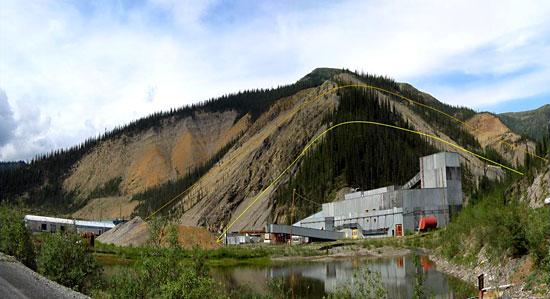
Alan Taylor: Mississippi Valley Type, yes the originally discovery was a vein type, which occurs in a fault zone and can be seen on the mountains in Zones 7 and 8. It is very evident and that is where they went underground originally. (see the following picture where the yellow lines have been drawn on the photo)


Figure 3: Mineralization in the Vein Massive Sulphide. Note the yellow lines tracing the vein on the hill where the main deposit is.

Marco G.: That’s what is shown on your web site on the picture with the yellow lines marked on the side of the mountain?

Alan Taylor: That’s right. These veins can be traced the entire length of the property, although it is not continuous but you can see remnants of the veins as it continues in similar geology along the 16 kilometer length of the property. The focus for exploration development has been on this vein. In 1992, when one of the exploration holes went a bit deeper in the vein, and intercepted a second type of deposit which we term stratabound, which wasn’t known at the time during the Cadillac days. Stratabound is a little different from vein type. The vein type crosscuts all the geology and it is in a fault zone. Stratabound tends to follow the rocks a bit more. It is thicker, and has equal grades of Zinc but less lead and silver than the vein.

Marco G.: Thicker you say by…….?

Alan Taylor: Tens of meters as opposed to 2 to 3 meters for the veins.

Marco G.: So going as high as 20 or 30 meters?

Alan Taylor: Yes, the stratabound. But the stratabound, we don’t have any underground development on. It is 200 meters below our lowest level of development right now. We have only have drill holes, so it is still to be determined the exact nature of that beast. Right now 90% of our resource base lies within the veins still. 10% within the stratabound.

Marco G.: How deep is the stratabound from the surface?

Alan Taylor: 200 meters below.

Marco G.: Is it feasible for open pit.

Alan Taylor: No, there is no open pit here contemplated. It is entirely 100% underground operation. But the unique attribute of the stratabound is besides its thickness, is that it seems to be associated with the proximity of the veins. So as the mine develops, and the vein continues down for hundreds of meters, it runs into the stratabound, so you can actually contemplate into the future, when the development gets down at depth, you could be mining both vein and stratabound at the same time.

Marco G.: So, that would add tremendously to your…the stratabound is part of your inferred?

Alan Taylor: Yes

Marco G.: It is not measured and indicated as you are not planning initially…

Alan Taylor: That’s right. We’ve only explored the stratabound just over a kilometer strata-graphically at the mine site itself, whereas the vein right now from a resource perspective is over 2 kilometers. The stratabound is a little bit deeper.

Marco G.: So, if the stratabound follows the veins and you have 16 kilometers of veins but you only have 1 kilometer of stratabound because you haven’t looked for it yet?

Alan Taylor: Well, we have indications, through a couple of drill holes that are 2 kilometers to the south of the mine of stratabound material. But there is nothing put together to make up a resource yet, the detailed drilling is not there. But the plumbing is there, the stratabound material is there.

Marco G.: Plumbing in terms of geological plumbing?

Alan Taylor: Yes, very similar geology, throughout this 16 kilometers of north south part of the mining leases.

Marco G.: I remember, you are a geologist,

Alan Taylor: Yes

Marco G.: And you are very …it is different talking to people…talk to a broker….they emphasize things…and you being a scientist, you say it with just a straight face.

Alan Taylor: Yeah

Marco G.: You don’t get excited, and in fact, it seems like I’m trying to draw it out of you.

Alan Taylor: (Laughs) Perhaps I’ve been with it too long, I’ve been associated with this project for 15 years.

Marco G.: I see.

If you have the vein and the stratabound, and you’ve only defined the vein, and the vein is this long, the likely-hood is that the stratabound is that long. The stratabound is a lot thicker than the vein.

Alan Taylor: It has the potential to be, yes.

Marco G.: I did notice that the vein is a lot higher grade, almost double the grade of the stratabound.

Alan Taylor: Yes, so the vein has more revenue associated with it, as far as commodities go, in situ value and such, because of the high lead zinc.

Marco G.: But what about the mass of the stratabound, it is easier to mine?

Alan Taylor: It is easier to mine and you can mine more of it in volume, so you could make more feed for the mill. The vein constrains you from an underground perspective, as to how much you could mine, how many tons you can deliver to the mine.

Marco G.: Right, whereas in stratabound, you just dig away.

Alan Taylor: That’s right.

Marco G.: It’s more… less likely to meander?

Alan Taylor: Yes, and that wasn’t known about at all in Cadillac days. It has a lot of blue sky potential still. Even the present resource that we’ve defined is still open ended.

Marco G.: Yes, so there is great potential. I sure am glad I’m talking to you! It helps me understand.

Alan Taylor: Yeah, and even though there’s a long history for the project, there is still a great exploration potential out there, it is a big property.

Marco G.: Now, certain investors look at the grade of the ore. Your company is called Canadian Zinc and you have 10% Zinc, 7% lead and 200 grams Silver and maybe a fraction of percent of copper how much ballpark wise would the ore be worth relative to the ore from somewhere else? In the Noront discovery, they said the ore was worth $6000 dollars per ton.

Alan Taylor: I hesitate to put a real number on it, but it is very significant when you can compare it to gold mines on an equivalent basis as far as ounces per ton. It all depends upon what numbers you put in. If Silver doubles at this time next year, we’ll call it a Silver mine again… (laughs)…which it could do! Because originally it was permitted as a Silver mine.

Marco G.: Oh really. Well, I like Silver, as in all my writings, I know your average Silver mine can make a go of it at less than 200 grams per ton, 200 is great, they can do it at 50 grams, just depending upon how close it is to surface.

Alan Taylor: Yeah, one of the needs to have for this area is high grade because we are remote, the transportation costs are big to move the product out. It is not like a diamond mine where you can monetize by sending the product out in a baseball cap…(laughing).

Marco G.: Right, you have to have ten couriers, and only one is carrying the real stuff.

Alan Taylor: Correct, matter of fact, back in the 80’s, the Hunt brothers were going to airlift their copper concentrate out which contains the bulk of their Silver values.

Marco G.: Oh, the copper and the silver go together.

Alan Taylor: Yes.

Marco G.: It is very interesting, there is lots of up side. So summing it up, why should an investor invest in Canadian Zinc.

Alan Taylor: Well, we’ve been around for many years, and some would stroke that against us, but I maintain and the reason I’m still here because Prairie Creek provides an opportunity, not just for the company, but for the region in general which is very poor in any economic development what so ever. Having infrastructure on site already, having it pre-permitted many years ago bodes well for moving it forwards and having it become one of the great contributors to the lead zinc inventories of Canada. Lead Zinc overall is looking very strong, we are almost at $1 dollar for lead zinc today, and the outlook is still very bullish for that.

And you mentioned earlier about some concerns for parks. It’s been dogging us for many years because there was a proposal to expand Nahanni Park many years ago. We’ve worked closely with Parks Canada and other federal agencies in discussing the matter and moving forward in a collaborative type fashion. We’ve done great strides in that respect, everybody is on side, when the park was expanded, we were mentioned by the Prime Minister in the same speech as our third party rights were protected and the rights of access. We continue to work with Parks Canada closely as far as moving together towards operations and they continue to work with the regulators also, as it is their first stab at actually moving an operation ahead, usually they are just parks related, but in this case they are both.

Marco G.: How about the natives? Are they on side as well.

Alan Taylor: The natives are another challenge, but we feel we have made great strides over the last fifteen years that we’ve been associated with them. We’ve done extensive consultations with them. One of the pieces that play on us occasionally is that the DehCho nations do not have a federal treaty settlement with the government. So there is some reluctance on their part to give anything away before they can establish what their arrangement is going to be with the federal government, but they at the same time recognize the paucity of economic development in their location. At this time, we are working closely in negotiations with a couple of communities for impact benefits agreements so that they can accrue some benefits for this operation also.

Marco G.: Great, thank you.

Assessment of the Potential of Canadian Zinc

The author was curious about the value of the high grade ore at Canadian Zinc and wanted an estimated value per ton. There is a simple calculation available with the on-line Kitco Ore Metals Value Calculator. Using a rough average of the total resources for the measured, indicated and inferred, the results are displayed in the following figure:


Figure 4: Estimated Ore Value at Current Prices. Note that the values are rough averages of the total ore resources including measured and indicated and inferred. The estimated value of $800 USD per ton is quite valuable relative to other miners.

Compare the estimated value of the CZN ore yourself with your own favorite miner.

The resources for Canadian Zinc in the 2007 43-101 technical report for Prairie Creek are only for the “Main Zone” at the mine site, but there are 13 mineralized zones altogether on a 16 kilometers trend in the property. A summary of the existing officially recognized resources is listed in the summary chart following:


Figure 5: Summary of CZN's Prairie Creek project. Note the high grades for the Silver, Zinc and Lead providing for a profitable 20 year mine life at present resources.

The third party author(s) of the technical report , MineFill state the following about mining:

  Robust project economics may reasonably be anticipated by virtue of:


  • The available resource grades


  • The fairly straightforward metallurgical process for co-mingled Main Quartz Vein and stratabound       material that yields acceptable silver, lead and zinc recoveries into selective lead and zinc concentrates: and


  • The likely limited amount of start-up capital required for mining and processing Main Zone mineralized material.

About the mineralization up side MineFill also state:

  It is also worth emphasizing that significant upside resource potential exists over several kilometers to both the north and south of the Main Zone area: the preliminary results indicate the presence of high-grade, vein type mineralization; and preliminary analysis suggests that structural continuity of the vein-type mineralization might exist. Additional stratabound mineralized bodies might also be present.

Therefore, this is a third party opinion, and this author concurs, that the resources could be much increased because of:

1. Trend extensions of the Vein mineralization to North and South

2. Extensions of Vein mineralization to depth

3. Mineralization in the stratabound, (20 to 30 meters thick) which parallels and underlies the veins

Canadian Zinc discovered these new Stratified Massive Sulfides (SMS) mineralization in 1992 that underlies the original Vein (VMS) mineralization discovered much earlier. As Mr. Taylor indicated, the geological indicators are positive for SMS potential bodies under all the VMS zones. The SMS mineralization is relatively lower in grade averaging 5% to 6% (which is still high grade), but the mineralization in SMS areas are 20 to 30 meters thick (relative to the 2 or 3 meters for the VMS).

The author is aware of the current deep drill that is testing an extension 4 kilometers to the North of the mine site. Such is the manner of these self-effacing gentlemen, of Canadian Zinc that they did not even mention the possible upside from this deep hole drill program that they are presently doing.

Summary

The author sees Canadian Zinc as a hidden gem for a longer term hold. The resources in place are high grade with stellar relative value. The existing official resource makes for a robust mining operation at the main site. The possibility of further exploration potential is almost certain, due to the Vein on trend and to depth. There are already discovered multiple zones to be further delineated officially. There are also the possibilities of the stratabound SMS thick mineralization underlying all their Vein zones. Overall this is a large property with much further potential. The Deep Drill results should soon be forthcoming.

For production, Canadian Zinc has an intact pristine mill and infrastructure that is 95% complete. Only minor upgrades such as a higher efficiency generator are required. The mining plan is relatively straight forward without complexities or cyanide usage. The mining tailings are proposed to be returned to the stopes for backfilling. Large capital expenditures are not expected to be required.

The permitting process for Prairie Creek is nearing closure on the previously fully permitted mining operation. The local inhabitants appear to be supportive and will participate in the economic benefits, that a production mine will bring. The previous uncertainty about the Nahanni Park Reserve was already concluded with an exemption for Canadian Zinc’s mining properties.

For Canadian Zinc (TSX:CZN, OTCBB:CZICF) it may be as Mr. Taylor says with a straight face, and without emotion that “there is blue sky potential at this open ended deposit”.

The author is long Canadian Zinc (TSX:CZN, OTCBB:CZICF)

Important Disclaimer

The information and opinions contained within this document reflect the personal views of the author and should be viewed as food for thought and amusement only. The author may from time to time have a position in any of the securities mentioned. There are no guarantees of the accuracy, reliability or completeness of the information contained herein. Independent due diligence and discussions with one’s own investment and business advisor is strongly recommended. These writings are not to be construed as an offer or solicitation with respect to the purchase or sale of any security or as an endorsement of any product or service. We do not request or receive compensation in any form in order to feature companies in this publication. It is prohibited to copy or redistribute this document to any type of third party without the express permission of the author. This document may be quoted, in context, provided proper credit is given.